Updates from Letty – April 24, 2026
Blog posts are the personal views of Letty Hardi and not official statements or records on behalf of the Falls Church City Council
Dear Friends,
After another marathon 5+ hour work session on budget, anyone who tuned in can’t say we’re not diving in and thoroughly considering the budget! We’re about 2 weeks from the finish line, with budget adoption on May 11. This week’s update is mostly a good news story – we heard positive Q3 financial results, a deep dive on the police budget, although with no state budget there is still a fair amount of uncertainty on top of an already uncertain economic and regional environment. We are hearing from the community about your priorities around transportation safety, solar investments, teen room upgrades at the Community Center, paving, schools, and alleviating the growing tax burden. Budgets can be detailed, boring, and wonky so I’ll wrap up with how I’m thinking about the budget, some reflections after 10 years of budget cycles, and another FAQ I’m fielding “how is all of that commercial revenue helping my tax bill??” I’d welcome your thoughts.
Community input is valuable as we work toward final decisions – it helps guide our priorities, highlight community needs, and ensure that the budget reflects the values of the entire city. You can continue to share your thoughts via email, at our public meetings, at the budget town hall on Thursday, or Ask the Council Office Hours on May 6. I appreciate the feedback I got from last week’s post – if you missed it, it was about how property assessments are determined.
Take care,
Letty
PS – Join me on my final set walking office hours today at 5 pm on the W&OD/West End Park with a guest – former Alexandria Mayor Justin Wilson and now Executive Director of NoVA Parks. We’ll be meeting at the intersection of the trail and West End Park, near Grove Ave.
What Happened This Week
(1) Police Budget Deep Dive
We heard a deep dive on police priorities and unfunded needs from Chief Fard. A few specific takeaways:
- Falls Church continues to be a very safe community even with population growth: overall crime is down 1.17% and the per capita crime rate is down 8% — lowest in 17 years!
- Staffing and accreditation: the police department is nearly fully staffed and accreditation process is underway, with first-time accreditation anticipated fall 2027.
- Compensation arms race: Arlington County Police raised starting salaries to $90,000, triggering regional adjustments. The proposed budget raises entry level officer starting salary to $76,000, which is competitive with most regional peers while not attempting to match Arlington.
- Unfunded needs: additional officers, fleet, overtime funding, civilian positions with increasing FOIA requests with body-worn cameras, technology upgrades, facilities (the Office of Emergency Management and Fire Marshal have operated out of a trailer at the Property Yard with no running water or bathroom). An operational review study is underway with recommendations on staffing levels expected to come out this summer to impact next year’s budget.
(2) Q3 Revenues & Current Budget Deliberations
First the Q3 results – which is mostly good news, but worth digging into beyond the headline
- The Little City That Could: we saw stronger-than-expected revenues in Q3 (Jan-March 2026) with increases in car tax, sales tax, and meals tax growth above projections. Some warning signs – hotel taxes continue to underperform, attributed to broader economic uncertainty and less travel to the region.
- It’s not that simple: we probed a bit into the revenues to understand whether this is a trend or a blip – staff explained that car tax increases are due to new residents’ cars that were previously uncaptured and with new buildings close to full occupancy, this will plateau. Some of the sales tax growth is due to one time purchases for construction projects, some of it is incremental spending at new businesses.
- Bottom line: after accounting for debt service for Meridian High School and topping up the Unassigned Fund Balance (the city’s rainy day fund) per our financial policies, staff is projecting a $680K surplus at the end of FY26. Per revenue share, around $340K of that surplus would be shared with FCCPS. FCCPS will also have their own end of year accounting.
What does this mean for next year’s budget (FY27)?
- Based on Q3 data, staff revised FY2027 revenue projections upward by $700K. Great, that means we have $700K more in revenue to spend, right?
- We discussed options to deploy the $700K cautiously, with a majority supporting a compromise option that would cut the tax rate 0.5 penny to slightly offset the high assessments and allocate the remainder per revenue share. The city’s share would go towards road paving and street maintenance. From our work session discussion a few weeks ago, none of us were happy the paving budget had been cut even below levels two years ago to balance the budget. More history on how paving has been underfunded and how we’ve been rebuilding the paving program since the Great Recession is in that post.
Letty’s Thoughts: this is a way better place to be in than last year, when last year’s Q3 results showed a worse-than-expected performance and we prudently made the decision to pare back the budget. And certainly easier budget than our neighbors (Arlington just adopted their budget this week, with a 2 penny increase in real estate taxes.) We have an enviable position and that merits pause and perspective.
Long term thinking: that said, our strong revenues this year are due to 2 areas – real estate property assessments coming in hot and our local economy, both of which are somewhat attributed to new construction and new businesses. Without commercial growth next year, finance staff’s revenue forecast is -0.7% to 4% in the worst to best case scenario (see Budget Q&A #29) and that is top of mind for me. City budgeting should be a multi-year and broad exercise across the entire’s city needs – not just funding immediate needs and wants but keeping in mind long term fiscal health, investments needed for the future, risks on the horizon (eg, fuel costs that drive up all costs, Metro funding with no state solution, etc), and the City Council, as the only body with taxing responsibility, determining what should be a reasonable rate of budget growth that taxpayers should sustain.
Taxpayers should be at the table: this year’s budget is mostly due to high real estate values with Falls Church continuing to be a desirable place to live with limited housing supply (high demand + low supply = high prices). With the median homeowner bill expected to increase $611 next year due to assessments – I hear the concerns that it’s the highest jump in years – and households feeling stretched, I believe taxpayers should see some of the good news.
Needs, especially schools’ needs: having seen 10 budget cycles now, there are always needs and unmet needs even in the best budget years (and minus one Covid budget, we’ve had a remarkable era of strong revenues). Budget season is the time of year when we hear from all the city departments and the community about their priorities and we’re responsible for balancing the full scope of city services—schools, public safety, infrastructure, parks, transportation, and more. I get it – everyone comes out and advocates for their areas which feel like the most important to them. Good governance means making decisions that serve all residents—students, families, seniors, businesses, and taxpayers alike – and we take that responsibility seriously.
As I write about this every year (see my November 2025 and March 2026 posts) – we obsess about school enrollment in Falls Church, mostly because we’re a small school system and we can’t easily flex and make school boundary adjustments like other districts can. And because a key driver of school funding needs is enrollment – we expected 150+ more students last year and enrollment turned out to be flat. That’s good news for building capacity. Right now, even with new residential buildings that have opened – enrollment has recovered from pandemic declines and remained relatively flat overall (the entire region and Virginia’s school enrollment is actually expected to decline which has broader implications) This matters because long-term budget growth should align with long-term demand. When enrollment is stable, it’s reasonable to carefully evaluate the pace of spending growth. That doesn’t mean schools don’t have needs—but it does mean we should ground operating and capital decisions in future needs, future revenues, and historical patterns of spending.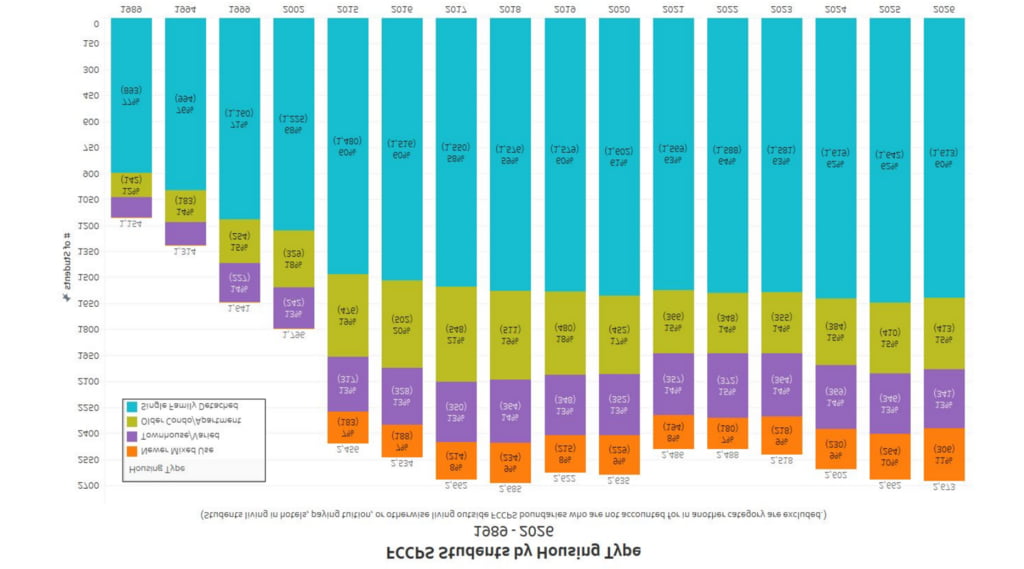
Speaking of historical patterns – regardless of the needs, due to the revenue sharing arrangement and strong revenues, school funding has healthily grown every year (from Budget Q&A #31), as well as ending every year with a surplus above the schools’ 2% fund balance policy.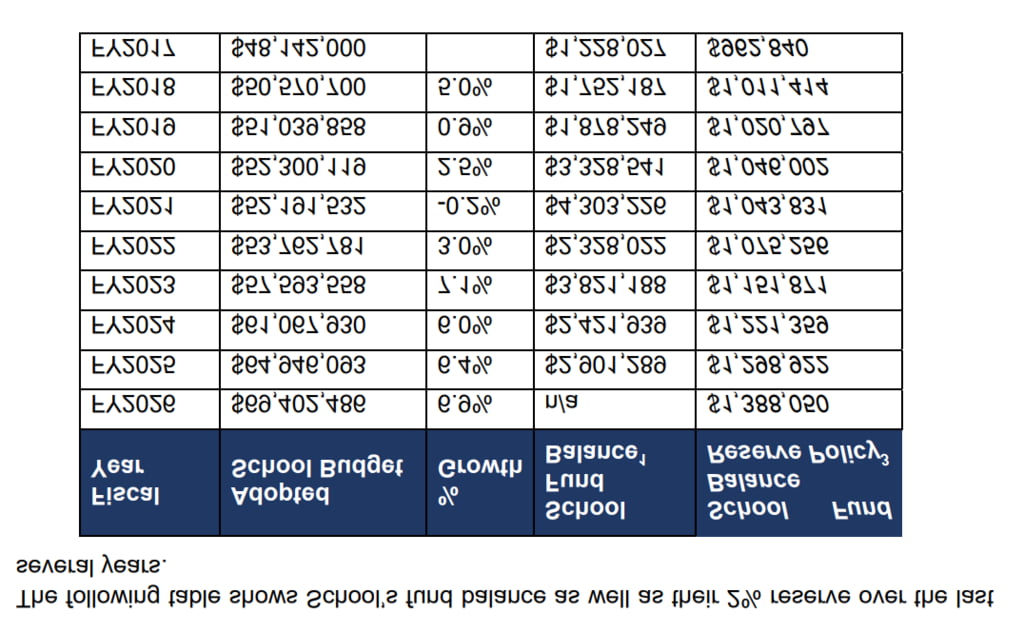
A need for flexibility: IMO, strong revenues are not a sure bet even with good Q3 results. Knowing that there are storm clouds around us– even if our new construction has somewhat insulated the city from the brunt of what our neighbors are feeling – now is not the time to be spending all of this good news. My preference is to give tax relief through a tax rate cut – both to help taxpayers but also temper operating budget growth – and judiciously put the remainder into the most critical priorities that can easily be paired back should the revenue picture change again or expenses surprise us. To me, that is not FTEs given that it’s much harder to reverse once you’ve hired a new employee. We all expressed a preference in fixing the last remaining structural issue in the budget – we’ve relied on one time money to boost the routine road paving budget to catch up from the 15 years of underfunding and this is our opportunity to fix it. Any new paving funds wouldn’t be spent until spring, allowing time to monitor whether revenue projections hold.
(3) Budget FAQ – how is all of that commercial revenue helping my tax bill?
Short answer: it has helped your tax bill – we’ve been able to lower the real estate tax rate significantly and mixed use projects generate $4.5M net revenue per year (that’s net revenue – after all service costs are accounted. $4.5M is about the equivalent of 7 cents of real estate tax, in other words, the tax rate would be 7 cents higher if we didn’t have commercial development. On top of that, revenue from West Falls project is directly paying for high school debt service as we committed to voters in the 2017 referendum). But to be transparent, we’ve also been spending it – besides debt service for the high school – also city hall, library, catching up on backlogged operating needs, hiring more staff, investing in transportation and housing, and the biggest chunk towards employee and teacher compensation. Budgets have grown across the board.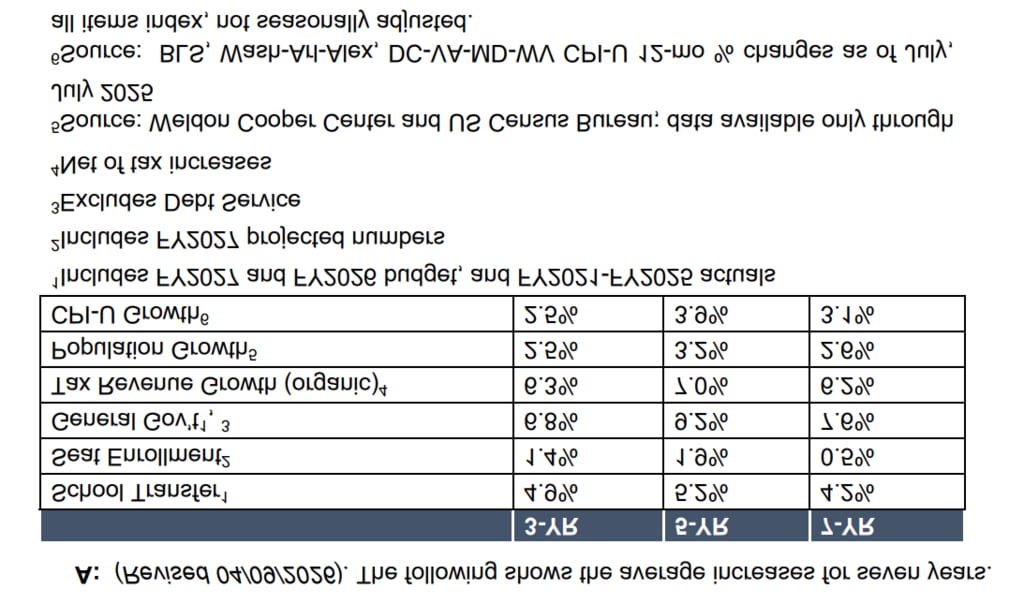
Long answer: below are two super useful looks at the composition of real estate revenues over time and in comparison with our neighbors. Real estate revenues make up 60% of the city’s total revenues and we’ve been on a 20+ year journey to diversify that tax base.
You can see that over time, we’ve shifted the blue bar (residential property) lower by adding more multifamily apartments (orange bar). Residential property (single family homes, townhomes, condos) now makes up a smaller portion of the city’s real estate base than 10 years ago.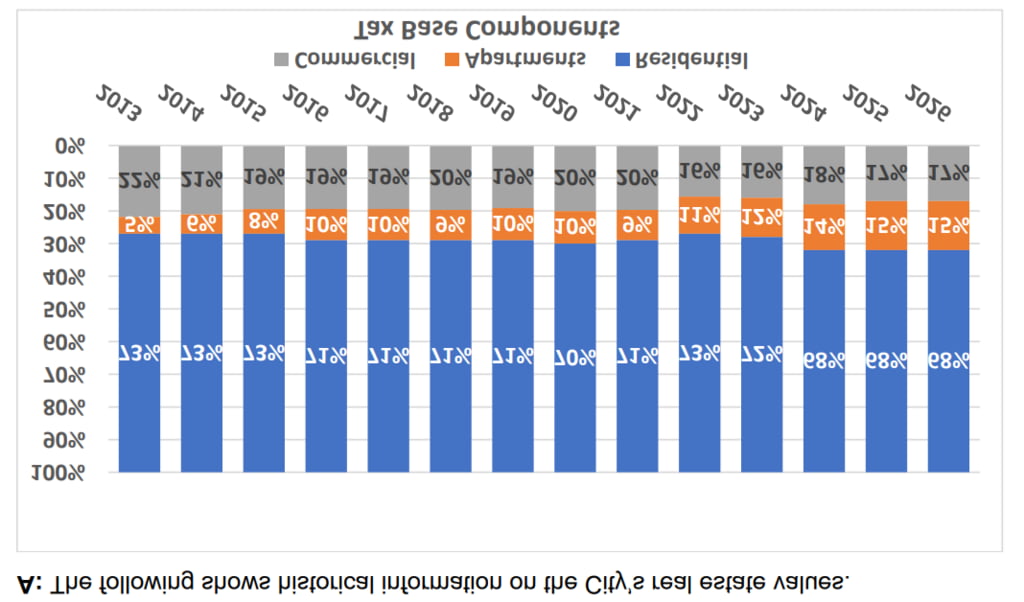
While every jurisdiction has seen commercial real estate values decline as a portion of their total real estate (due to less demand for office and retail even pre Covid) – other than Fairfax County, Falls Church is the only jurisdiction that has also seen residential portion decline, ie – we’re less reliant on residential real estate taxes than 10 years ago. The diversification strategy is working! And putting aside the fiscal benefits, we’re also just a more vibrant city than 20 years ago. We’d be seeing even more dramatic gains, except that residential assessed values have skyrocketed and even a 17 cents decrease on the real estate tax rate doesn’t offset those high assessments which means your tax bills have still steadily increased.
Finally, significant commercial growth is what makes this year’s budget in Falls Church “easier” than our neighbors. Take a look at our local economy’s revenue assumptions vs our neighbors. This has implications for what that means when growth tapers off this year.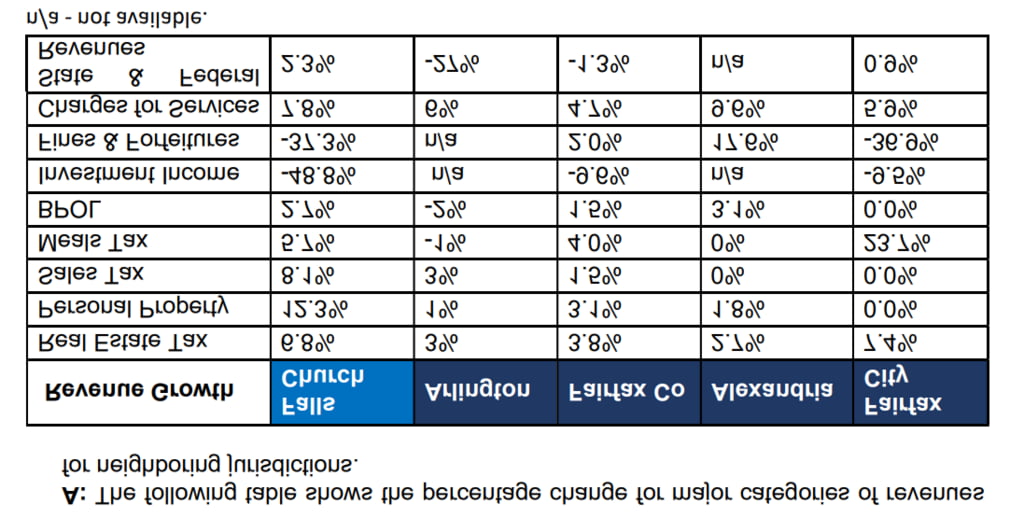
What’s Coming Up:
April 27 – City Council Meeting & Work Session* (budget)
May 4 – City Council Work Session* (budget mark up)
May 11 – City Council Meeting* (budget adoption)
*All Mondays (except 5th Mondays and holidays) at 7:30 pm. You can access the agenda and livestream here, including recordings of past meetings
Office Hours:
Letty’s Walking Office Hours – Friday, April 24 (5 pm, W&OD / West End Park)