Updates from Letty – October 10, 2026
Blog posts are the personal views of Letty Hardi and not official statements or records on behalf of the Falls Church City Council
Dear Friends,
We took a break from housing this week and dove into something that doesn’t always get the attention it deserves: bus service in Falls Church and across Northern Virginia. I know many of us are not regular bus riders – I am not either. But this week, I challenged myself to try and failed. On Monday night, when I was returning from DC and arrived at East Falls Church Metro station, I was planning on riding the F20 Metrobus to get to the City Council meeting. But the bus was running late and me literally running back into the city was going to be faster. That really reinforced for me that bus service needs to be more frequent and reliable for it to be a genuine alternative over other modes of transportation.
Bus Rapid Transit (BRT) has been talked about for Rt 7 for over 10 years. Moving ahead with some form of BRT does offer a chance for buses to be more frequent and reliable. Read on for the options we heard and the latest guidance we gave to staff this week – as always, I look forward to hearing your input.
Have a good long weekend – City Council is back in session next Tuesday, October 13 after the holiday.
Best,
Letty
What Happened This Week:
Bus Rapid Transit (BRT) Options
We heard a joint presentation from city staff and regional partners NVTC (Northern Virginia Transportation Commission) on the latest options and modeling for a regional BRT project along Rt 7.
Some background:
- NVTC has been studying concepts for bus rapid transit along Rt 7, a regional effort called Envision Route 7, since 2013.
- 57K live along the Rt 7 corridor from Tysons to Alexandria and the current Metrobus F20 runs along this corridor, through Falls Church.
- For the cars that travel through the city, NVTC estimates that 60+% of the destinations are outside of the city – this is a good reminder that Rt 7 and Rt 29 are large, regional thoroughfares which requires regional transportation solutions and coordination.
- The Metrobus F20 route carries 2.4M people each year. It’s not only the busiest route in Northern Virginia – it’s actually the busiest in all of Virginia!
- In Falls Church, we’ve long said we care about shifting modes of transportation to be more multimodal – ie, away from single occupancy vehicles, in our transportation and land use policies by making it more walkable, bikeable, increasing connections to transit, and adding more commercial options in the city that don’t require car trips farther away.
If we want more people to use transit, we need to make it a genuinely competitive option. One way to do that is BRT, which combines frequent bus service with features that help buses move faster and more reliably. Dedicated bus lanes are a big part of that equation, along with transit signal priority, better stops, and faster boarding. We are already moving forward with one piece of the puzzle: the City has secured a $1.4M grant for transit signal priority (TSP) at seven intersections along the Rt 7 corridor. This technology can help buses spend less time waiting at red lights. We also expect a new express/limited-stop Metrobus service, the F2X, to launch in December, providing more frequent service during peak toll hours on I-66. Both are welcome improvements and will be a helpful test case for further improvements for bus service.
Most recently, two specific BRT designs were studied for our stretch of Rt 7 – full and partial BAT lanes (business and transit access lanes, ie lanes for buses and turning movements) along Rt 7 and Rt 29. Dedicated bus only lanes were not studied given constrained lane width in Falls Church. Dedicated bus lanes will likely be part of the plan elsewhere along the Rt 7 corridor outside of Falls Church where the street is wider.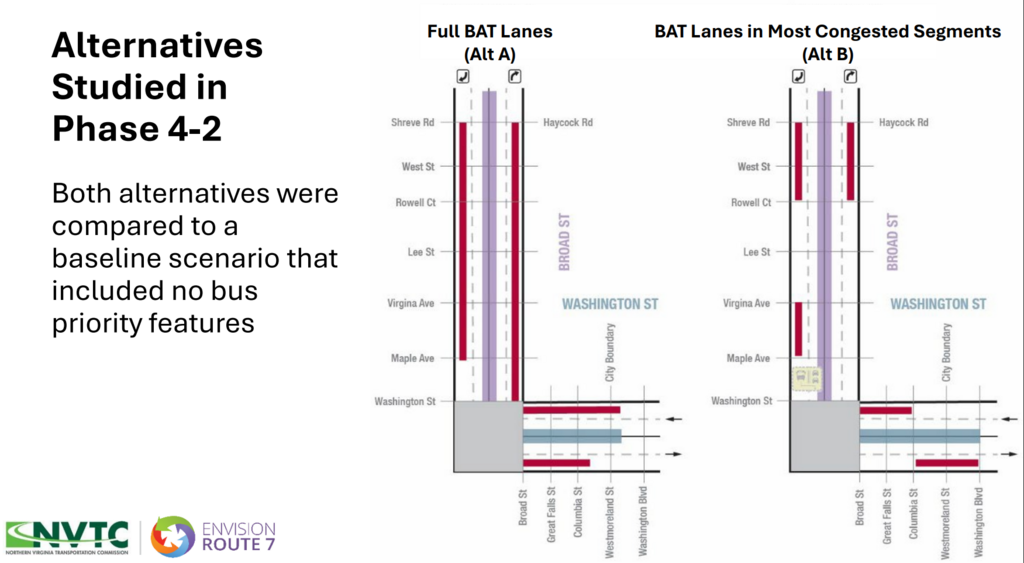
The Council discussion reflected different levels of comfort on our two corridors:
- On Broad St, we are moving forward with Transit Signal Priority as the near-term strategy, while continuing to consider what additional improvements might be possible with a request to study and identify funding for partial BAT lanes.
- On N Washington St, there was broader support for advancing partial BAT lanes as part of the N Washington Multimodal Improvements Project, which already has $22.5M in regional funding. Concept design and public engagement are expected to begin next summer.
- We also discussed whether dedicated bus lanes could operate only during peak hours, when buses face the greatest delays. That flexibility may help us capture significant transit benefits while limiting impacts on other traffic. Several of us also raised the possibility of a pilot approach that would let us test some changes and learn from the results before committing to a larger investment.
Letty’s Thoughts: optimizing buses with signals and a more frequent service like the F2X are good incremental steps. But how do we build a transit system that people will actually choose over driving? This is where the conversation gets harder.
Traffic modeling suggests that bus lanes could increase delays for drivers at some intersections, and we have to take those impacts seriously. Nobody wants to make an already frustrating commute worse, or send traffic onto neighborhood streets with unsafe driving activity. But I also think we need to challenge an assumption that often drives these conversations: that preserving the maximum number of lanes for cars is always the best way to move people. The main metric for comparing these different options remains “level of service” for intersections – which is simply about wait time and throughput for cars. A bus carrying dozens of passengers and a car carrying one person are competing for the same limited road space. If we measure success primarily by how quickly cars move through an intersection, we miss the bigger picture – I think we should also ask how many people are getting where they need to go, how reliably they can get there, and how much total time they spend traveling.
That’s why I asked staff to look at metrics beyond the traditional “level of service” metric, which largely measures delay for vehicles. Person-throughput and person-hours of delay can help us understand the broader impact of our transportation choices. This isn’t about ignoring drivers. It’s about recognizing that drivers are not the only people using our roads — and that giving people a reliable alternative can benefit everyone.
When we make transit more reliable, we give people a reason to change how they travel. Some drivers may choose the bus instead. Others may combine trips, walk, bike, or adjust their schedules. That shift doesn’t happen overnight, and it depends on providing good service. But if we never give people a compelling alternative, we shouldn’t expect their habits to change.
We also need to account for what happens if we do nothing. The regional modeling presented to City Council showed that congestion is expected to increase even under the no-build scenario*. Keeping every lane as it is today is not a guarantee that traffic will get better tomorrow.
*But does it? Will traffic actually increase? Below is one of my favorite charts no one ever believes, but I’ll keep sharing! In Falls Church, our population has grown by roughly 30% since 2010, while VDOT recorded vehicle volumes have actually declined. (And while volumes have increased on some neighborhood streets, that increase is still less than the total decline in car volumes across the city.) That doesn’t tell us everything we need to know about future traffic, but it does challenge the idea that more people must inevitably mean more cars on our streets.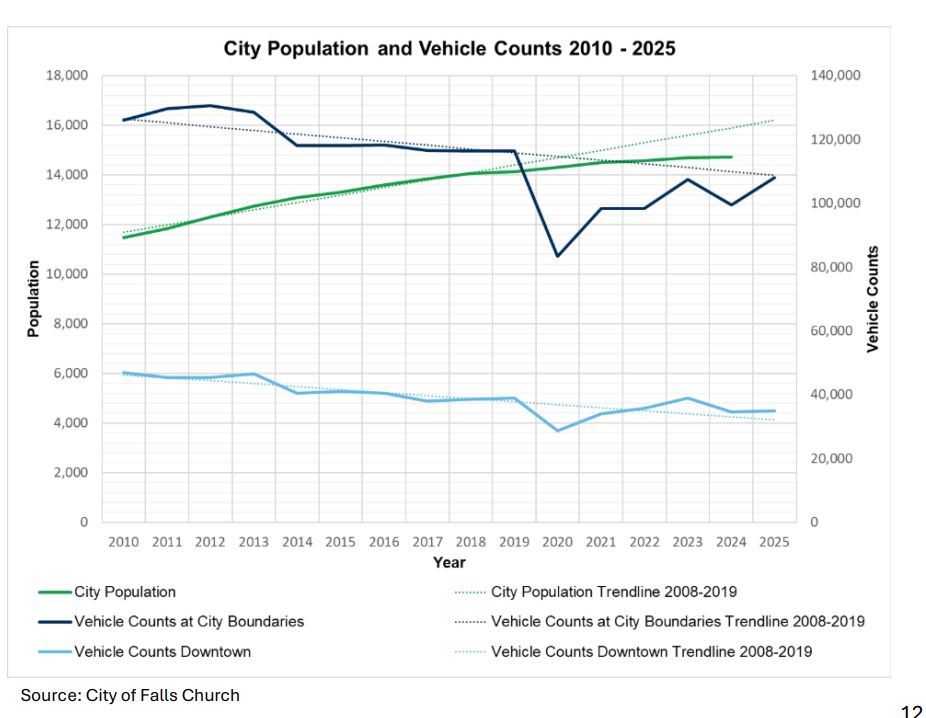
What’s Coming Up:
Tuesday, October 13 – City Council Meeting*
Monday, October 19 – City Council Work Session*
Monday, October 26 – City Council Meeting*
*Mondays (except 5th Mondays and holidays) at 7:30 pm. You can access the agenda and livestream here, including recordings of past meetings
Letty’s Fall Office Hours:
Tuesday, October 20 – 630-8 pm (The Cheese Cartel)
Wednesday, November 18 – 630-8 pm (Lucky Thai)