Updates from Letty – October 2, 2026
Blog posts are the personal views of Letty Hardi and not official statements or records on behalf of the Falls Church City Council
Dear Friends,
Did you know that it’s National #WeekWithoutDriving? Every October 1-8, this is an opportunity to rethink how we get around and better understand the experiences of people who rely on public transit and other transportation options – whether it’s due to a disability, the cost of owning a car, or other barriers to driving. To be clear, this is not saying everyone can or should stop driving. It’s an opportunity to think about the trips we make every day and consider: What options would I have if I could no longer drive? Even trying one trip without driving can help us better understand what’s working, what’s not, and why transportation options matter in our community.
It’s a privilege I can get around on foot or bike most days (although I drive plenty especially when schlepping groceries for a house full of teenage boys or going to kid sports outside of the city). I biked to the PTA meeting last night at Meridian, and it reopened my eyes to the challenges our students face biking or walking to school – curb cuts with turning cars, big intersections, no real protection from car traffic. I saw that Mustang Alley, which has vastly improved over the past year with construction nearly done, could use a longer pedestrian signal for one to safely get across Haycock Rd.
This week’s post:
- To continue with the theme of #WeekWithoutDriving, I’ll bring it back locally and how this relates to the discussion on parking policy at Virginia Village. Parking is one of those topics where everyone has an opinion – so before coming to an opinion of my own, I often try to learn about a topic first. The rest of the votes we took were largely covered in work session last week, so I’d review that post or look at the meeting summary.
- Read on also for two topics at the state and national level that merit more awareness and engagement. If you haven’t heard, there are proposed changes to the 2030 Census and you can weigh in on the proposed Dominion-Next Era merger.
And coming up:
- #WeekWithoutDriving is great timing – next Monday night in work session, City Council will be discussing Bus Rapid Transit (aka, BRT) options in Falls Church. We’ve been talking about BRT on Rt 7 for over 10 years. Why BRT, how does it help traffic, and with limited width on Rt 7 in Falls Church – what are the options, short and long term, and tradeoffs?
- Join Falls Church Forward next Thursday, October 8, 6-7:30pm at Grillmarx for a happy hour and learning social: Why Do We Drive So Much. No background needed — come with questions and opportunity to meet a new neighbor!
- And with the rainy weekend ahead, get your fall cleaning done with the city’s Recycling Extravaganza on Saturday morning. For a quieter and cleaner fall, you can recycle old gas leaf blowers, lawn mowers, and other yard tools.
I hope you’ll consider joining the #WeekWithoutDriving and share your experience!
Best,
Letty
What Happened This Week:
(1) Virginia Village (and parking requirements)
The TL;DR on Virginia Village – we voted for a new “first reading” on the zoning changes for the Virginia Village zoning and will be referred out to the Planning Commission for their input. This is actually the third first reading. Why three? Since we embarked on this process a year ago where staff presented a process where zoning code and the RFP processes would run in parallel, we have been intentionally keeping the door open to update the code. We knew as we hear from the community on compatibility, discuss, and iterate based on market response (ie, will someone be able to finance and build affordable housing based on this code?) – we could be evolving the code language. The tweaks we voted this week will allow for more flexibility as we work with Urban Atlantic, the city’s top ranked offeror, in the next stages of the development.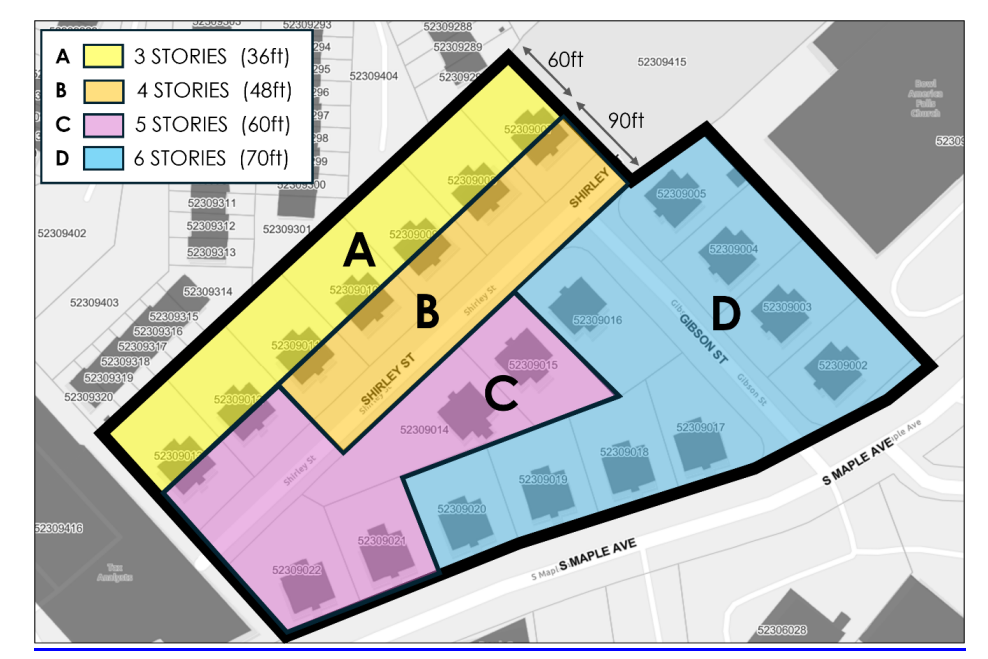
Parking requirements are one part of the zoning code that we debated and has a pretty big impact on housing development. As proposed, the requirement would be 0.6 space per affordable unit and 1 space per townhouse in the district. That’s actually slightly higher than a new state law just passed in the recent General Assembly session.
To have an opinion on whether these are the right or wrong requirements, I’d first suggest understanding how parking mandates are even determined. I’d suggest this 10 minute read or 30 minute especially entertaining video to understand that parking mandates are mostly arbitrary and have been made up over time.
Here are my takeaways and why parking policy is important at Virginia Village and across the city:
- Parking is costly on many levels – in Northern Virginia, a structured parking space costs about $50K per spot to build and to recover those costs, builders pass them onto consumers – increasing rents or the subsidy needed in the case of affordable housing. Besides driving up the cost of housing, parking mandates also means overbuilt parking takes up valuable space that could otherwise be used for homes, trees, open space, or other community needs. increases emissions, encourages sprawl, and harms local businesses.
- And while no one believes it, we have overbuilt parking such that we have excess spaces in many of our garages in Falls Church. Our past utilization data shows this.
- Parking is an important amenity for residents – so builders have every incentive to figure this out and build enough in order to rent or sell their homes. If they build too little parking, they have a problem. If they build too much, they’ve spent millions of dollars on spaces that don’t generate much value. They are actually in a much better position to “right size” parking based on the location, the residents, the market and the availability of other ways to get around.
- Lowering or getting rid of arbitrary mandates doesn’t mean we get rid of parking – it just means we let the market work and right size the amount of parking that is built.
- Meanwhile, government has a role in managing adjacent street parking to encourage turnover near commercial properties and limit any monopolies of street parking spaces with overnight parkers.
- The communities that have lowered or eliminated parking mandates still have parking. Parking still gets built – it just allows for more flexible, real time decisions and more people using other modes of transportation too.
I expect more conversation on parking requirements – to be informed by actual utilization data. Note that data also shows low income households own far fewer cars than the general population (in 2022, 30% of low-income households did not own or lease a vehicle, compared to just 3% of high-income households).
(2) 2030 Census
Earlier in September, the Census Bureau proposed a rule that would change who gets counted in the 2030 Census, where they get counted, and what questions get asked. Several of these changes could put an accurate count at risk:
- Non-citizens and green card holders only. The count would, for the first time, exclude students on visas, workers on visas, refugees and undocumented immigrants.
- A possible legal-status question. The Bureau is weighing whether to add a question about legal or citizenship status to the census form.
- A narrower definition of “usual residence.” Instead of counting people where they live most of the year, the rule would count them where they spent the most days during a new January 3-April 1 window. This could misplace seasonal residents (e.g. “snowbirds”), students, and other mobile populations who don’t fit that narrow snapshot.
- Heavier reliance on administrative records. The Bureau would lean more on tax, immigration and other government records to determine residency instead of self-reported information. This shift could risk missing renters, part-time workers, students, young children and others who aren’t well captured in those records.
- The end of race, ethnicity and other demographic data. Race and ethnicity questions – asked on every census since 1790 – would be eliminated entirely and most other demographic questions would become optional. Communities rely on this data to track equitable service delivery, target economic development, and meet federal reporting requirements.
Together, these changes could shrink the count in communities across the country. Every undercounted household means fewer resources for the entire community, not just the households that go uncounted.
The Census Bureau is accepting comments on this proposed rule until October 13, 2026. We discussed in our City Council Meeting that we will be sending a letter. To easily submit a comment of your own – you can use a fillable form provided by the National League of Cities here to Congress or submit a comment directly to the Federal Register.
(3) Dominion-Next Era Merger
ICYMI – Dominion Power announced a merger with Next Era back in May to create what they said would be the largest regulated electric utility business in the world. The merger is under consideration with Virginia’s State Corporation Commission (SCC) with a deadline for the SCC to complete its review by Jan 2027.
You can visit the SCC’s Dominion-NextEra Merger webpage for information about the case, upcoming hearings and ways to submit public comments: Virginia SCC – Dominion-NextEra Merger. Written public comments can also be submitted to the SCC through November 9. If you’d like to go in person, there is one public hearing in Northern Virginia scheduled for next Friday, October 9, from 6 to 8 p.m. in the Board Auditorium at the Fairfax County Government Center, 12000 Government Center Parkway.
What’s Coming Up:
Monday, October 5 – City Council Work Session*
Tuesday, October 13 – City Council Meeting*
Monday, October 19 – City Council Work Session*
*Mondays (except 5th Mondays and holidays) at 7:30 pm. You can access the agenda and livestream here, including recordings of past meetings
Letty’s Fall Office Hours:
Tuesday, October 20 – 630-8 pm (The Cheese Cartel)
Wednesday, November 18 – 630-8 pm (Lucky Thai)